The Case for Camming
While fan platforms get all the attention, data shows cams as a powerful tool for creators, especially in a hostile market.

Lately, adult creators have gotten relatively gloomy about the state of the creator economy. Nearly 60% of creators think it’s gotten harder to earn money in the past year, and almost half say their income has decreased. But in untangling the data, we found one creator group significantly more optimistic than the rest: cammers.
In our most recent State of the Creator survey, “cammers” — which we define as those who primarily earn money from live streaming — were the most likely to say that their income had risen, and the least likely to feel that earning money is getting harder. Cammers still face many of the challenges of other creators, of course, but the data suggest that cammers may be more insulated from the whims of censors, algorithms and banks.
While camming hasn’t gotten the attention that fan sites have in the last few years, data also suggests that in many cases, creators who at least partially incorporate live streaming into their work are doing better financially than their non-streaming peers.
With creator-heavy XBIZ Miami approaching, we thought it was a good time to examine the data on cammers and other live streaming creators to understand what we might learn. Special thanks to Stripchat who not only is working with us to help better understand the data, but also agreed to sponsor this post, giving SWR the freedom to go a bit deeper than we normally would be able. Thanks to their sponsorship, we’ll be able to donate $1,000 to Pineapple Support, which provides many cam creators with free and low-cost mental health services and support.1
Who Is Camming?
Over the past few years, we’ve seen the overall percentage of creators who cam or live stream drop as media has relentlessly hyped fan platforms. Fan platforms like OnlyFans have attracted millions of new creators with the promise of high payouts and higher returns, resulting in an increasingly competitive creator market. For many of these creators, live streams like camming may be an afterthought. That may be costing them money.
In Fall 2025, SWR anonymously surveyed over 550 adult creators, most based in the US, Canada as part of its annual State of the Creator survey.2 This and previous years’ data gives us an unprecedented look at how the market for cams may be shifting. To start off, let’s look at the state of the overall market for cams.
Who Cams? About 40% of adult creators we surveyed use live streams in some capacity. Of those “streamers,” one-third (35%) are dedicated “cammers,” meaning live streaming is their most important source of income. For the rest, streaming is as an add-on to another main income source, most commonly sexting, fan site subscriptions and clip sales.3
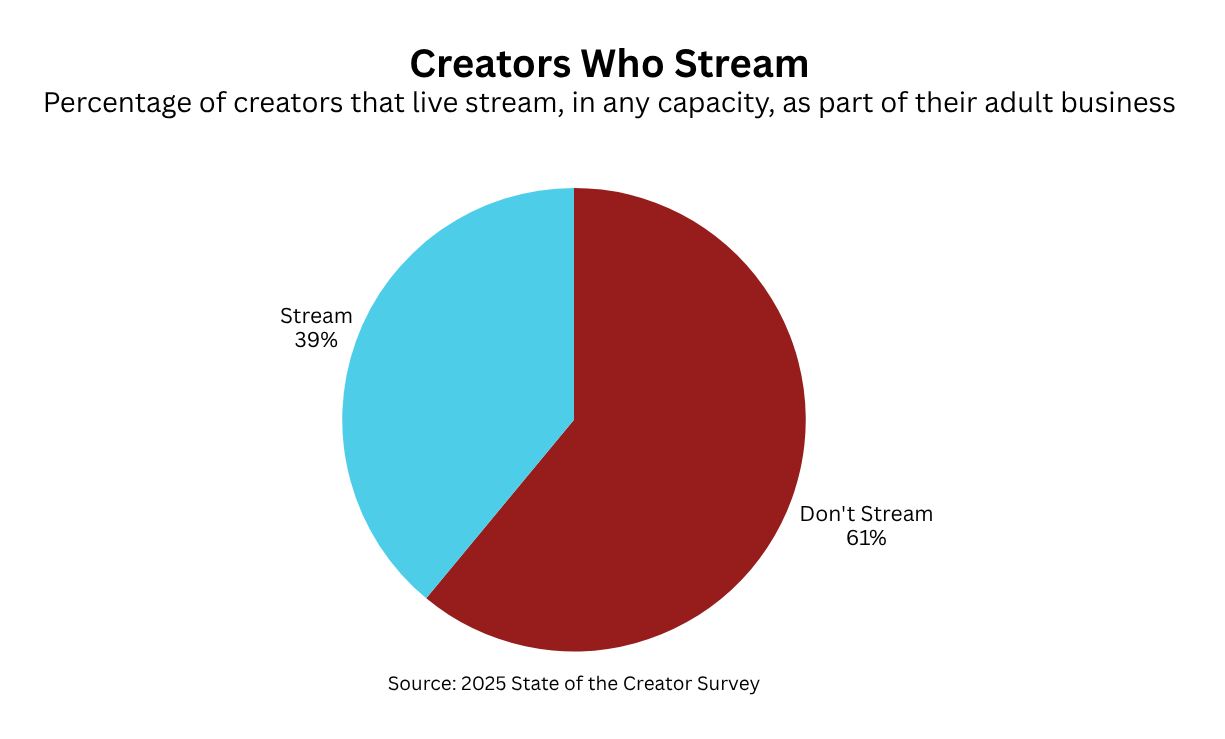
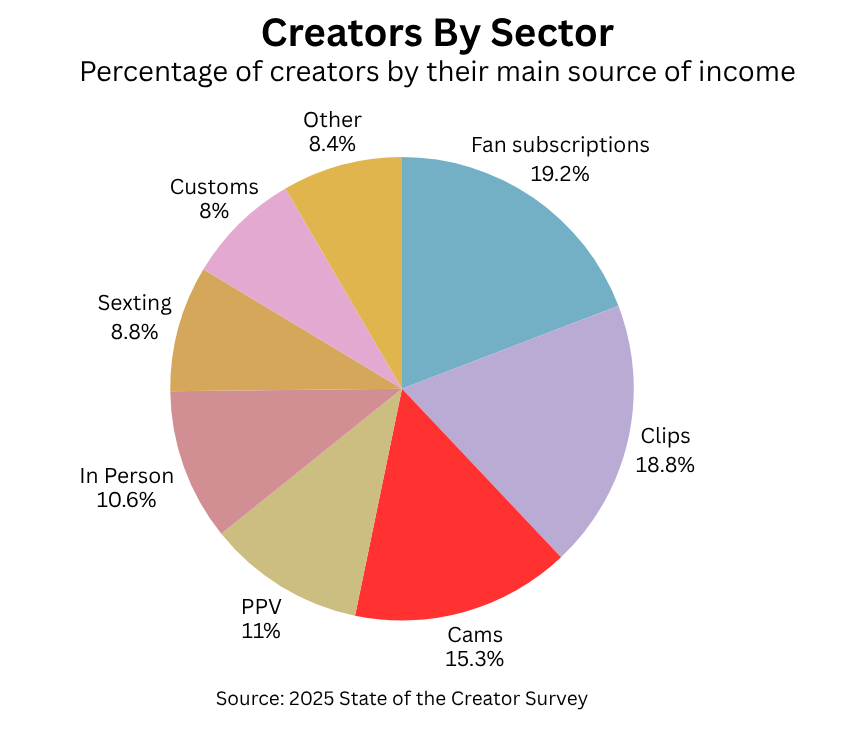
Live streaming is the main income source for about 1 in 6 creators (15%) overall. While the activity may be the same, the business models for these dedicated “cammers” and the broader community of “streamers” vary tremendously, as does their income.
So do the populations engaged: in our survey, dedicated cammers tended to be slightly younger than the more casual streamers, and the data suggests that newer creators are starting off as cammers before diversifying. Cammers also tend to be whiter and cis female than the creator population as a whole.
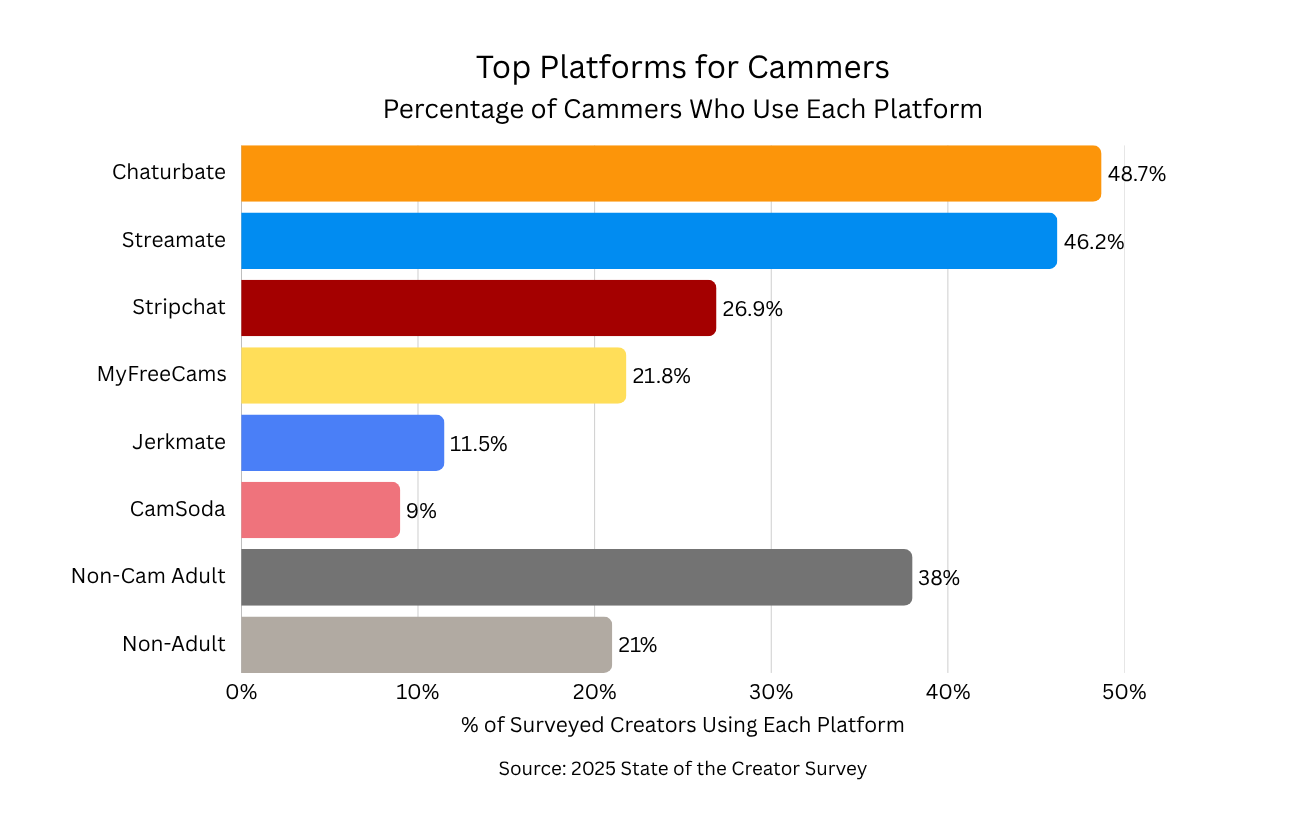
Where Do They Work? While many fan platforms allow adult creators to stream, 91% of cammers have a profile on at least one official cam platform. (About 75% of streamers do.) About 1 in 3 cammers streams on a non-cam platforms like Fansly or SextPanther and a smaller percentage (21%) use non-adult platforms like Zoom or Discord.
Cammers aren’t just camming. Like other creators, cammers have a diverse income portfolio. Among these dedicated cammers:
67% also sell fan content:
56% sell clips
50% sext
28% earn through phone sex
The overlap between sexting and phone sex is particularly significant: for cammers, SextPanther is as almost as important a revenue source as OnlyFans.4
Creators are streaming, just not always on cam platforms. Most creators who stream do it at least partially on a cam platform. Even creators who stream primarily through a fan site generally have a cam profile on a site like Streamate or Stripchat.
These more casual “streamers” use cam platforms significantly less than those who make their main living through camming. (Around one-third of streamers only use fan sites or non-adult platforms like Discord or Facetime.) While they may be live streaming, they’re less likely to see the benefits that dedicated cammers do when it comes to income stability or growth.
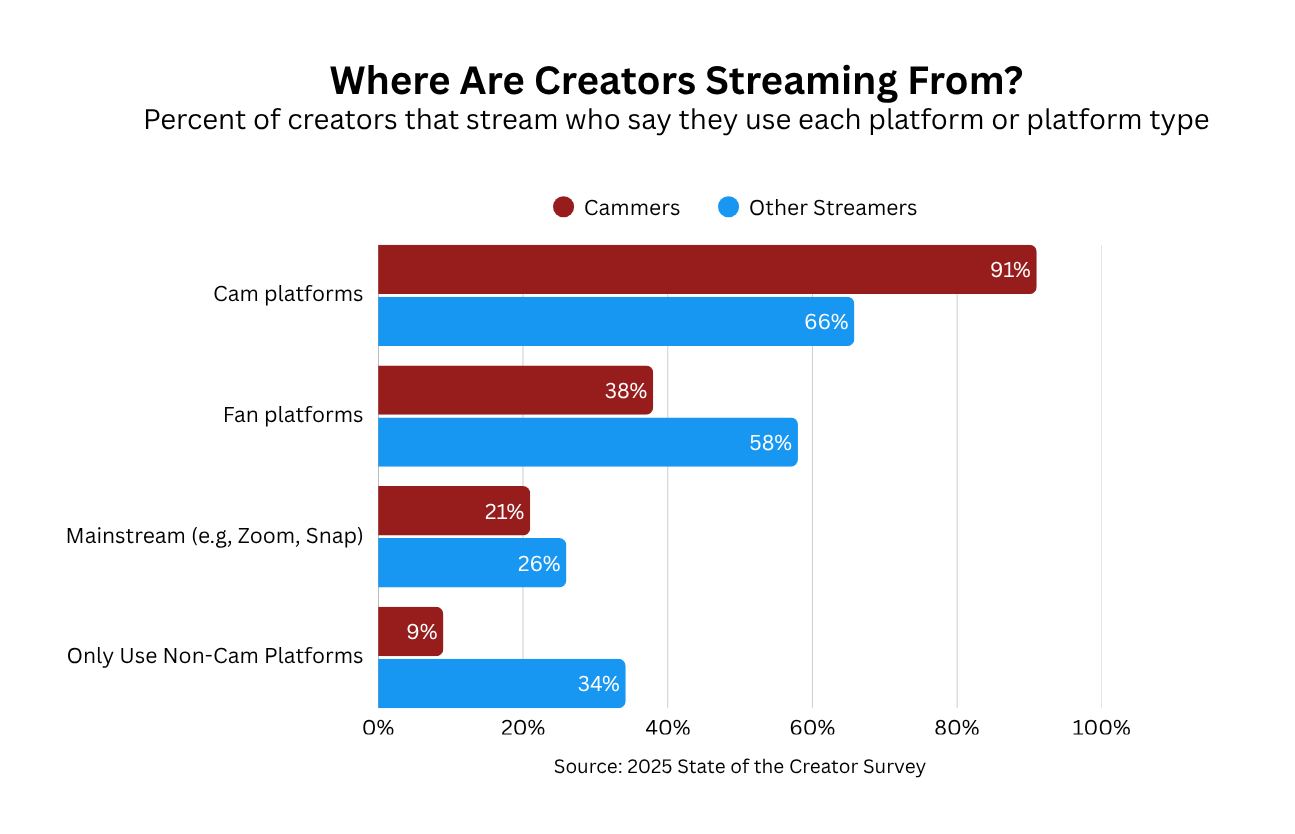
What the data suggest is that camming isn’t just another way of earning money, it’s a different way of structuring an adult creator business. Cammers do need streaming solutions that allow them to monetize to different audience sectors and across different platforms, but that doesn’t mean the solution for cam platforms is to simply imitate fan sites. Similarly, not every one who streams wants to making camming the focus of their business, and data suggest that most streamers see platforms as a tool.
Untangling the value for each type of streaming creators is critical for understanding how they can leverage the various creator platforms.
As attacks on the industry heat up, from banking discrimination to age-verification, cammers are weathering the storm better than other creators.
Camming’s Safe Harbor
Camming presents an interesting paradox. In general, cammers have a lower average annual income than other creators. Yet, unlike their colleagues in other sectors, the income of most cammers is stable or growing. As attacks on the industry heat up, from banking discrimination to age-verification, cammers are weathering the storm better than other creators.
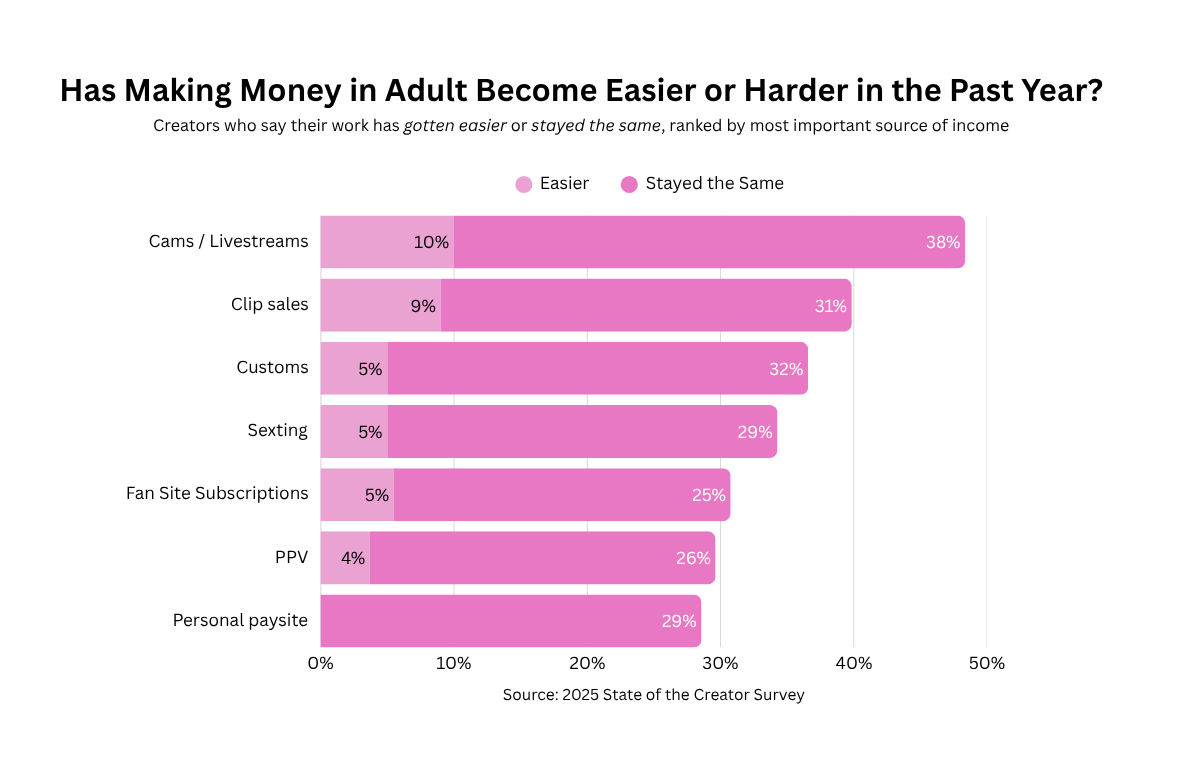
For example, nearly half of cammers (48%) report that earning money in adult has gotten easier or at least stayed the same over the past year, while just 30% of those working in fan sites could say the same.5 That’s a significant gap.
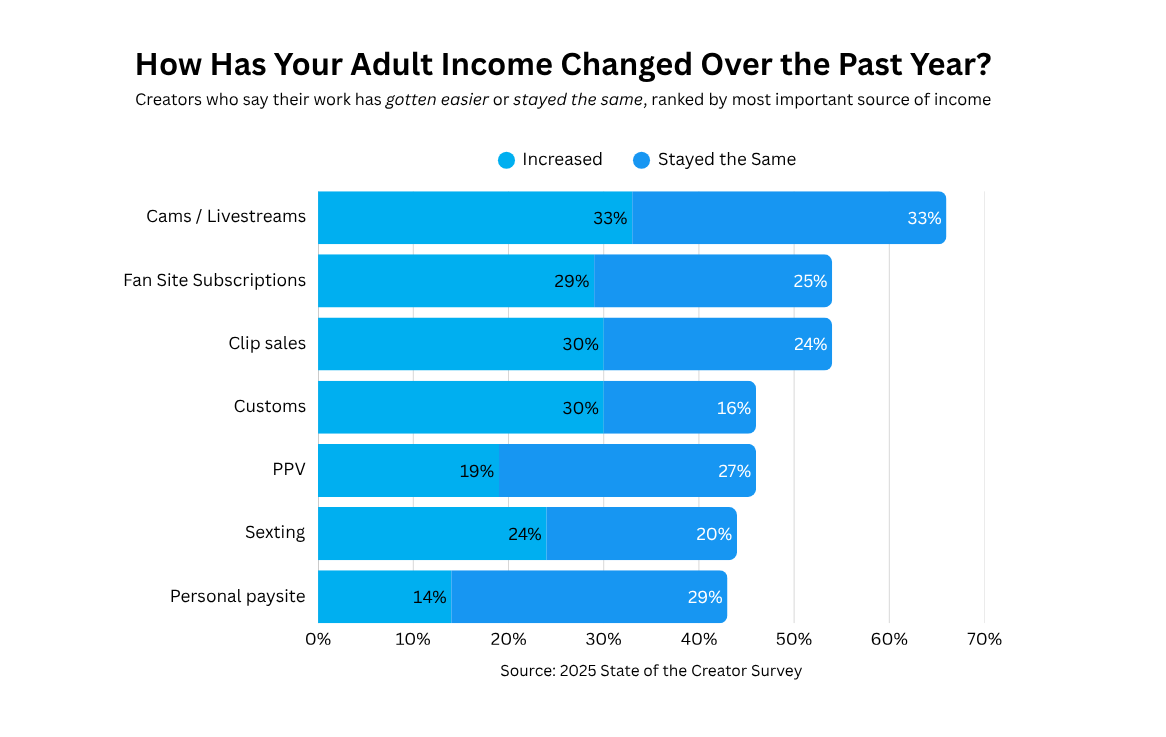
We see a similar pattern emerge with income growth. More than two-thirds of cammers (66%) said their income had increased or at least stayed stable over the past year, while other creators struggled.
The reasons for this are complex. But at least some of data points to the impact of antiporn laws and regulations. Data show that age-verification laws have significantly impacted creator income, with some individual creators blaming it for losses of 50% or more. But that’s not the only impact of increased hostility toward sex work.
Increased social media censorship is reducing creators’ ability to market
Content restrictions on platforms is reducing what creators can sell
Banking discrimination is reducing creators’ ability to sell direct to consumer
Each of these adds friction to the sales funnel. When a fan has to get a VPN to log into a platform, when a creator has to rework an edit to avoid a ban-triggering word, when Paypal freezes an account, it throws sand in the gears of a successful business, increasing the time from production to sale. More and more creators are being forced to spend more time navigating bureaucracy and less on production and marketing.6
Again, here we see cammers with a distinct advantage over other creators. We asked creators to identify the biggest challenge to their ability to earn money in adult. Cammers were the least likely to rank social media censorship as the major problem. Other creators ranked it as their number one impediment to earning.
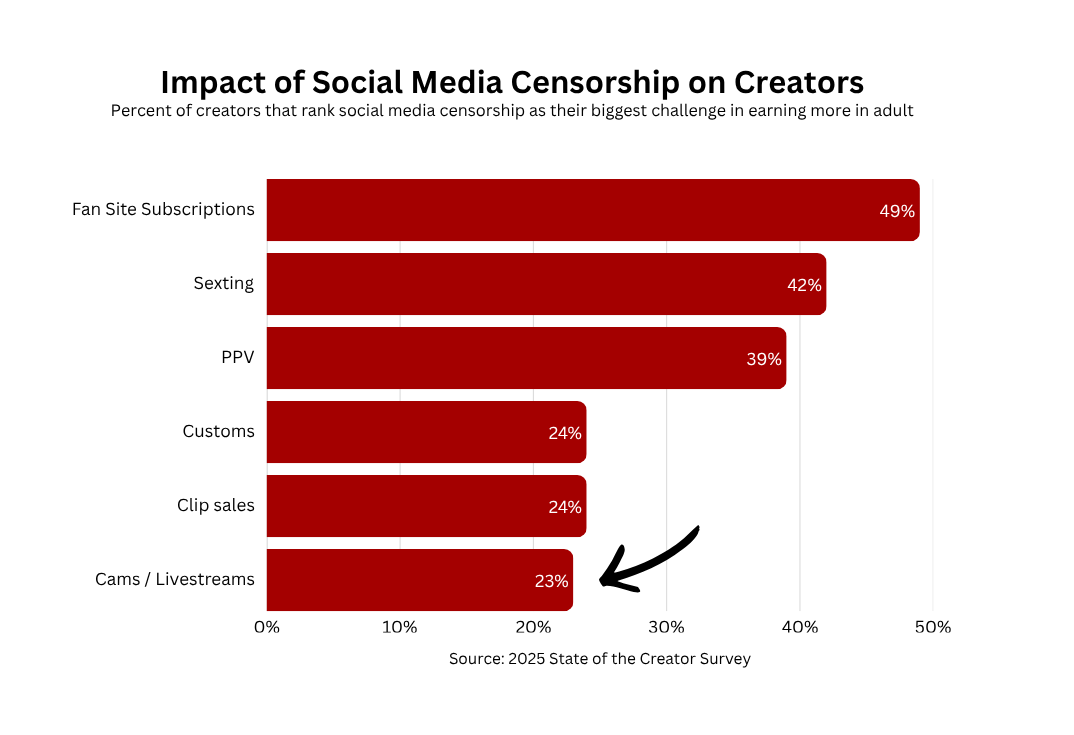
Cammers also appear to be among the least impacted by content restrictions. They were significantly less likely to have had content removed by an adult platform.
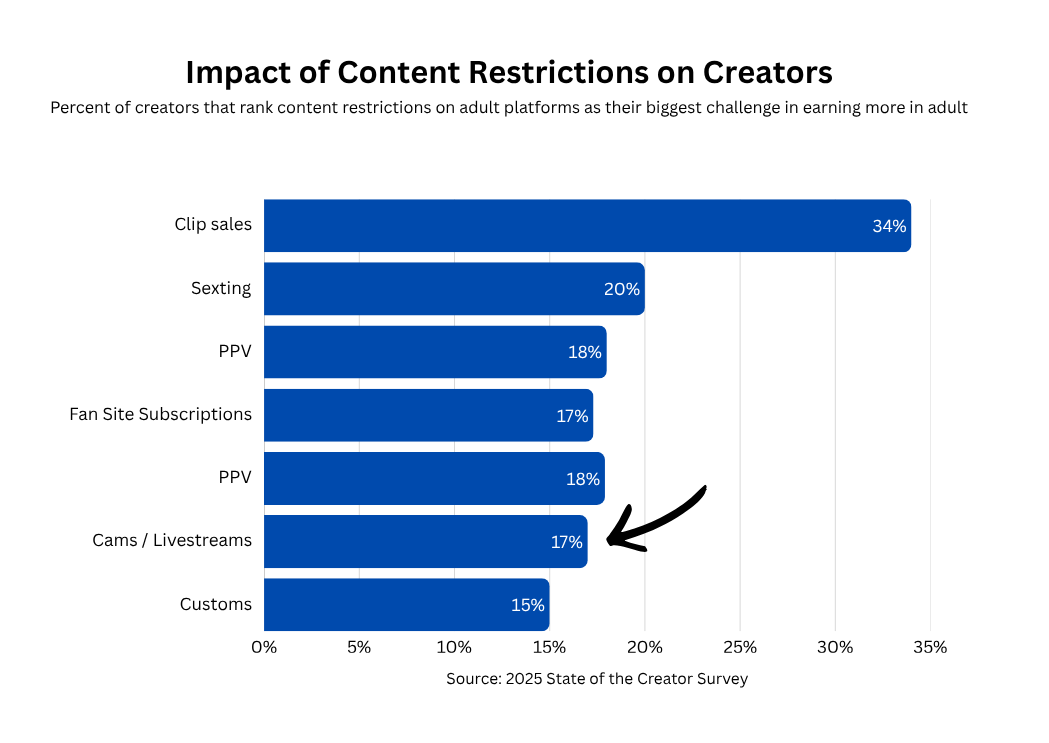
Overall, cammers were the group least likely to report negative impacts from the so-called “War on Porn.” Cammers had less trouble with fans accessing their content (as a result of age-verification laws), less trouble with piracy, fewer restrictions on what they can sell and, consequently, much less of a hit on their income.7
So what’s going on?
The Power of Internal Traffic
The reason behind this “safe harbor” isn’t exactly a secret to cammers: it’s cam platforms’ strong, internal traffic. Nearly 80% of cammers say a platform’s internal traffic game is crucial when choosing a platform. Cammers care about internal traffic more than any other single factor, and more than any other group does. Cammers view internal traffic as more important than having fewer content restrictions, a higher payout percentage, better design, or stronger data. At least in part, internal traffic provides ballast against the looming threat of social media bans, shadowbans, content flags, and algorithm changes. It also reduces the need for guerrilla marketing in places like Reddit and X, which are becoming more hostile to adult work.
While most creators can’t imagine a world without 24/7 social engagement, many cammers revel in it. Nearly 1 in 3 cammers couldn’t even identify a single social media platform “most important” to their adult income. It’s not that cammers aren’t on social media, but it doesn’t hold the same power it does over other creators.
Just 14% of cammers said social media was their most important source of new fans, far below “cam site appearances” (46%) and “internal traffic” (21%).
Streaming As an Income Driver
We’ve mostly focused on “cammers,” creators whose main source of adult income is live streaming. But most creators who stream are not cammers, they just use live streaming as an occasional tool to generate income. Do those creators get the same benefits as cammers?
The data here is mixed, in part because, it’s difficult for us to separate the once-a-month Fansly livestreamer from the clips creator doing regular private shows, or the new creator trying out camming for the first time. What, where and how often you stream likely makes a big difference as to what income you generate and the benefits you enjoy. In some instances, streamers behave more cammers, in others, non-streamers. We’ll dive more into this in future surveys.
What we can tell is this: creators who stream have some of the most diversified revenue streams, a factor which necessarily opens them up to more risk (hello, social media censorship), but also gives them the opportunity for higher incomes. On average, part-time streamers had higher annual incomes than either dedicated cammers or creators who don’t stream at all.8
On average, part-time streamers had higher annual incomes than either dedicated cammers or creators who don’t stream at all.
Cam Platforms Attracting Different Types of Creators
Creators use camming platforms in diverse ways, but based on the data there are a few key factors worth identifying. We looked at the three most popular platforms among State of the Creator respondents and found that they are attracting different types of creators.
Chaturbate. Chaturbate has the broadest user base among creators we surveyed About 42% of creators who stream said they use the platform (compare to Streamate, 27% and Stripchat, 20%). Chaturbate excels particularly with creators who aren’t primarily cammers. Creators as a whole view it positively — it made it onto the SWR Hot List earlier this year.
Streamate. While Chaturbate has broader appeal, Streamate appears to be the cammer’s cam platform. Among dedicated “cammers,” Streamate is the single most important source of livestreaming income. More creators in our survey use Chaturbate, but creators who invest in camming as a career are more likely to credit Streamate for their income.
Stripchat. Stripchat was the fastest-growing platform among creators we surveyed. In 2024, just 13% of streaming creators said they used the platform. That jumped in the past year to 20% this year — an increase of 56%. The platform saw similarly impressive growth among dedicated cammers. It’s particularly strong among newer creators.
How Cam Platforms Can Better Serve Creators
As the industry has shifted, platforms often struggle to identify what creators outside their own ecosystem want or need. Companies have a good idea as to how and what the creators on their platform want. They may have a general sense of what creators in their sector of the industry want. But they don’t always have a good sense of what creators outside their sector need and value.
A few items our data suggests cam platforms could use bring on more creators.
More opportunity for passive income. “Lack of resources and time” was by far the biggest factor standing between cammers and a growing business. Unlike fan-based creators, most of cammers revenue is generated live, which means income can be hard to scale. While cam sites shouldn’t expect to become fan sites, the ability to earn when not on cam could go a long way to reducing the dependence on streaming itself.
Interoperability. Dedicated cammers don’t seem to care much about allowing outside links, for example to social or other platforms. But other streamers — those who base their businesses around fan sites or sexting — do want those links because their main business isn’t on cam sites. Cammers are just a third of the streaming market, and expanding interoperability could help attract those who like streaming, but don’t currently do it on cam sites.9
Balancing Traffic and Payouts. Cammers understand the value of internal traffic, but most other streamers come with their own audiences. Both groups were more likely to value higher percentage payouts than non-streamers. (Fan-based creators, paradoxically, appear to the most satisfied with payouts). Non-cammers would benefit from understanding the power of internal traffic, even as cammers are pushing for rising rates.
The Case for Camming
Cams and clips, with their strong internal traffic, used to be the dominant form of creator content. Unfortunately, millions of creators haven’t known a world where they haven’t had to drive all their own traffic and sales. Camming may be own hustle, but State of the Creator suggests it provides some stability from an increasingly fragile marketplace.
“I always tell creators, especially new creators, to get on a cam site,” says MelRose Michaels, founder of Sex Work CEO and co-founder of SWR Data. “There’s so much competition on social media and there’s no better way to gain a following than going on cam. You build an audience from the traffic, you get to know the industry and your fans. It’s real time market research with an established audience. There’s nothing like it.”
MelRose built her following on cams before the creator economy took off in the early 2020s. While she still streams periodically, she’s now focused on growing businesses beyond content creation.
“Smart creators know to diversify, but that means going beyond just a handful of fan platforms and back-up social account. In this economy, you should be looking at multiple income streams from different sectors. Building a business that includes cams, clips, sexting is part of that balance.”
*Special thanks again to Stripchat for sponsoring this deep dive into the state of cams, as well as the State of the Creator survey itself, which was able to raise over $8000 for nonprofits serving sex workers. Their sponsorship not only makes the work we do sustainable, it helps SWR direct even more money to sex worker serving groups. Stripchat will be at XBIZ Miami.
While Stripchat did work with us, they did not have editorial say over the content of the post. Stripchat has been consistently interested in reports like this one as way to better understand creators, and have offered to share some of their internal data, to help us better understand the cam market. Such collaborations help us get greater insight into the cam creators, funds research that will help camming creators, and to raise money for sex worker orgs.
Stripchat and Chaturbate provided matching funds for the most recent State of Creator survey, which raised over $8000 for sex work nonprofits.
As always, important to stress that State of the Creator data comes largely from creators based in the US, UK and Canada. It’s conducted in English, which necessarily limits the reach. There are large communities of camming in South America and Eastern Europe that this doesn’t necessarily address, and more work is needed to bring those in in future years. When looking at the data, it’s always important to understand the strengths and limits of the current methodology here.
Creators can use live streaming in a number of different ways, such as:
A full-time cam model operating almost entirely on cam sites.
An OnlyFans creator who uses the platform for an occasional live stream
A fetish creator who arranges private sessions on Zoom or Facetime
While we might call all of this “camming,” the data can be difficult to untangle, as the traffic, income, payout and commitment for each vary wildly. Most of this report deals specifically with what we’re calling “cammers,” adult workers whose primary source of income is streaming, no matter what platform or method. Alternately, we refer to “streamers” to mean those who use some amount of live streaming in their adult work. All “cammers” are “streamers,” but not all “streamers” are “cammers.”
We asked cammers what platforms they used and what platforms they earned the most money from, on both cam sites and fan sites. On cam sites, Streamate was the largest source of income (36%) for cammers, followed by Chaturbate (28%).
Given OnlyFans dominance in the fan market, we allowed creators to choose their top two “fan” income sources. OnlyFans (42%) and SextPanther (37%) were far and away the biggest sources of income for cammers.
This year’s State of the Creator asked respondents to identify the platforms they viewed positively or negatively. The net positive ranking here is the percentage of creators who view the platform positively, minus those who view it negatively. Many other platforms were underwater, with a higher net negative than positive.
SextPanther is also the platform most beloved by cammers with a net 54% positive ranking, along with LoyalFans (+36%), Fansly (+35%) , Clips4Sale (+25%), Chaturbate (23%) and Stripchat (+10%).
Data excludes creators in their first year of adult work, since they have no point of comparison.
While it’s easy to blame platforms, they’re suffering as well. Platforms are having to pay exorbitant fees for age-verification, which has dramatically reduced the number of new fans. Some are defending against legal suits related to age-verification and paying millions in fines. Platforms have had to scale up moderation to guard against debanking, leaving less to invest in traffic and payouts.
These advantages didn’t necessarily carry over “streamers” (anyone who live streams for at least part of their adult income). This may be because so many streamers use fan sites as opposed to cam sites, or because opening oneself up to many different types of income streams increases the likelihood that you’ll experience one or more of the potential issues.
We’ll tease this out in future posts and surveys. Those who stream as part of their business tend to be more diversified than those who don’t. They may be further along in their career. What’s driving this increase is important in understanding how creators can take advantage of it.
Some cam platforms, such as Chaturbate, do allow links to fan sites and social media. This could explain why it is attracting a more diversified creator base.