How Much Money Do Creators Actually Make?
The average annual income for adult creators is close to $60,000. That's much more important than you think.

If you were to believe the New York Post or Daily Mail, adult creators are minting money. Amoranth’s $27M streaming empire! Belle Delphine $10M bathwater business! Riley Reid’s $5M Pasadena mansion! Sensational headlines suggest that if you’re not earning $75K a month as a giantess or paying your mortgage with feet pics, you’re doing it wrong. While some of this is just savvy PR, the narrative that adult content creation is incredibly easy and lucrative is everywhere.
So, unfortunately, is the idea that adult work is exploitative. Antiporn advocates, desperate to reframe sex work as something dangerous and coerced, routinely put forward their own dubious numbers. British SWERF1 Julie Bindel claims the average OnlyFans creator earns just £120 per month, accusing the platform of “pimping” the vulnerable. The faith-based National Center on Sexual Exploitation (NCOSE) uses similar numbers, and even goes so far as to claim that the top 1% of OnlyFans creators earn less than a McDonald’s cashier.2
But what do creators actually earn?
The question isn’t just a matter of accounting or accuracy. Disproportionate media focus on ultra-high earners affects creators’ self-perception and self-worth. It can set unrealistic expectations for those getting into the industry, or be used to denigrate the work itself as unskilled. Meanwhile, the extremely low revenue figures equate sex work with trafficking, and are used to justify increased censorship, policing and banking discrimination. Better data is both a business and a political issue.
The best way to get an answer? Ask creators themselves. In the most recent State of the Creator survey, we asked creators to tell us more about their financial situation, anonymously.3 We asked creators:
how much they’d earned in the past year from adult work
the percentage of their total income that comes from adult work
if they depended on other sources of financial support (e.g. another job, a partner or family, government assistance, alimony)
Together, they paint a much more accurate picture of modern creator economics.
First, the big number. According to the data , the average creator is earning about $58,700 from adult work annually, or about $5,000 per month.45 For most creators, adult work is … work. Content creation is neither the winning lottery ticket portrayed by the tabloids nor the labor trafficking scam portrayed by antiporn groups. To borrow the well-worn phrase, it’s a living.6
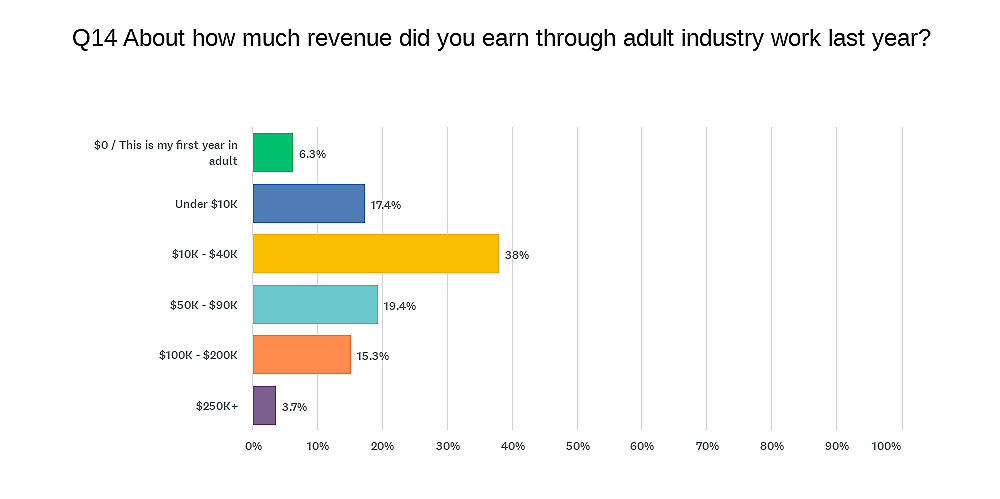
Of course, this average covers a broad range of different levels of work in the adult industry, from those who are full-time content creators to those who earn extra spending money sexting on the weekends. Some creators make significantly more, many significantly less. As with all economic numbers, the presence of a few very high-earners can shift the average up,78 as does a large number of creators working as a side-hustle shifts it downward. Both factors are at work here.9
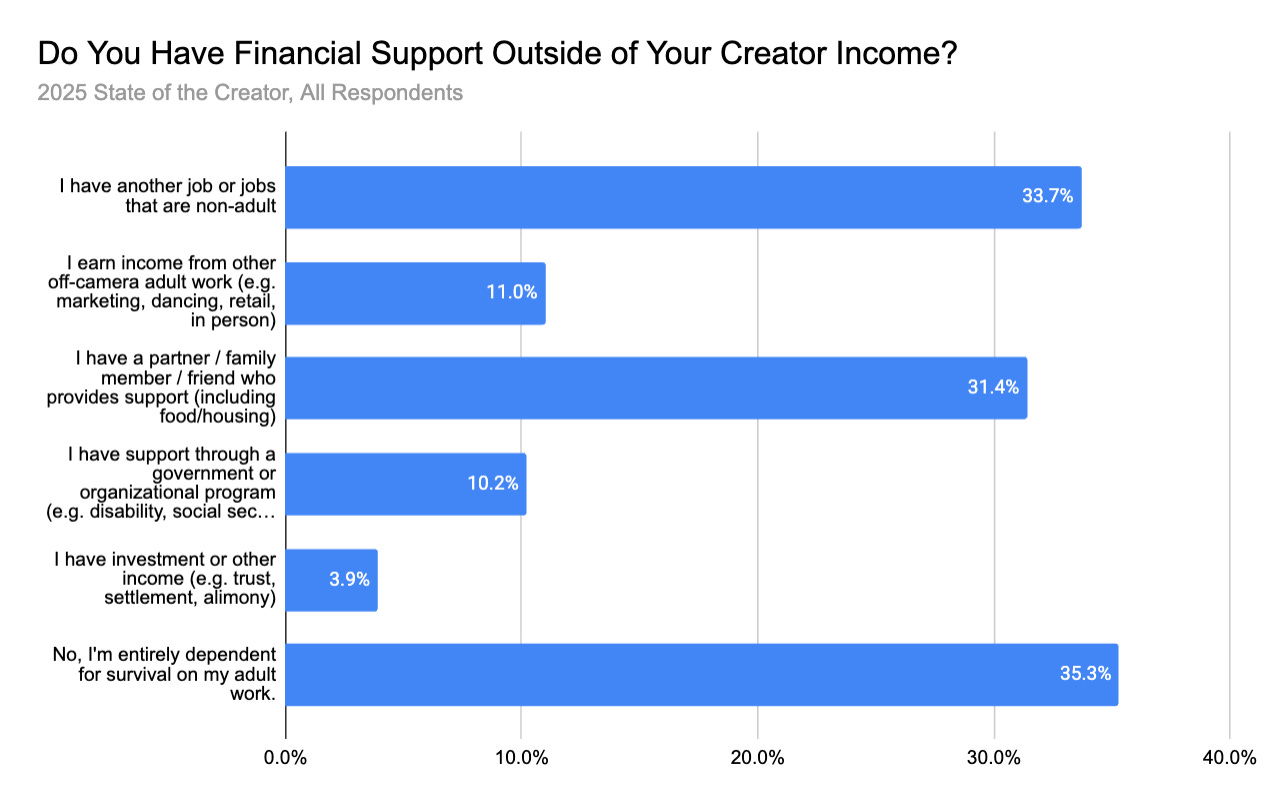
The data also show that more than half of creators (51%) said they earn income outside of the adult industry, making content creation a part-time job for most. In addition to non-adult jobs, creators cited additional means of financial ballast, such as a working partner, familial support, or government assistance. Just 35% said they were entirely dependent on their adult work for their survival.10
While many factors influence who earns how much (something we’ll dive into more deeply in a future post),11 one factor correlates with higher incomes more than anything else: the amount of time spent in the industry. For creators new to the industry, the average income from adult content creation it’s just $16,000. For those who’ve been in the industry for five years or more, it’s more than $74,000.
Average income rises even higher among those who only earn income through adult work. Creators who work entirely in adult and have been in the industry for over five years have an average income of more than $111,000.
In other words, sex work isn’t just work, it’s a career. And just like any other skilled labor, the amount earned rises with experience and commitment.
While more study is needed, the new data can begin to reshape the conversation around online sex work and the adult creator economy in a few key ways:
Creators should not measure themselves against media portrayals of online work, or solely against surface metrics (such as “Top 1%”) on sites like OnlyFans. Most people working in the space are doing so in a way that supplements income, building businesses that they hope can ultimately give them independence.
Platforms should rethink how they approach creators and how they can better serve them. Platforms often only see adult creators through the lens of their platform, not always realizing creators’ complex financial situation outside their platform — other jobs, other platforms, other demands on their time. As a result, too often, attention is focused on attracting high-earners, rather than servicing mom-and-pop businesses that are the heart of the adult creator economy.
The media needs to rethink how it portrays the creator economy and online sex work. By all means, continue to profile the big successes and the wild stories! After all, we’re carnival people. But not everyone has a mansion and a yacht. For many, the independence and freedom this work provides is more valuable than a number on an account balance.
Of course, the data only tell part of the story. We’re interested to hear what your experience has been and how it has (or hasn’t) been reflected in the data. Leave us your stories and questions in the comments, or reach out directly at info@swrdata.com.
Sex Work Exclusionary Radical Feminist, a self-described feminist who believes that all sex work is exploitation and should be outlawed.
The low numbers cited by Bindel and others all generally result from the same formula: divide by the total payout of OnlyFans by the total number of creator accounts. Under British law, OnlyFans is required to release both figures annually. However, OF never identifies how many of those accounts have been approved or ever used, let alone are meaningfully active. While this allows OnlyFans to boast of millions of accounts, it generates in absurdly low income per creator — something exploited by anti-sex worker groups.
2025 State of the Creator survey, conducted Fall 2025 by SWR Data, with over 550 adult creators. More on the survey, and how it’s conducted, here.
To calculate the average, we excluded creators who were not working in the industry or earned no money in the past year for adult work. We tallied the reported income of the remaining creators, ranging from a low of $100 earned to a high of $800,000.
State of the Creator survey most accurately represents the creator community in the US and UK (and to some extent, Western Europe). For more information, see our post on methodology.
This is slightly lower than the mean income of the United States, which was about $67,000 in 2024. However, for most creators, adult revenue is not their only source of income.
In contrast to the average (mean) income, the median income was just $30,000 a year, meaning there were an equal number of people surveyed earning more than $30,000 as there were earning less than $30,000. For creators who earn 100% of their income from adult work, the median income is much higher, around $50,000.
While a few high-end earners do shift the data, there’s also good reason to believe that higher end earners are underrepresented in this data. Creators in the higher or ultra-high brackets are more likely to use chat teams and managers to handle their online businesses, meaning they’re less likely to be accessible via social media or participating in mentorship networks with other creators, and thus less likely to participate in State of the Creator. Among those that did respond, our data showed that creators using chat teams and managers had a much higher mean and median income.
To better understand how much small-time earners and higher earners impacted the sample, we recalculated the mean and median after those earning $1000 or less a year and those who earned more than $300,000 or more. The mean (average) stayed roughly the same, around $54,000, while the median rose to $40,000.
To better understand the complex nature of creator finances, creators were asked about their income and support in different ways. In one question, creators were asked about the percentage of their income that comes from adult work. In another, if they depend on other forms of financial support (including non-monetary support such as housing or food) outside of their creator income.
There are significant differences in earnings by age, gender, race, industry sector and even platform adoption. Some of these will not be entirely surprising (e.g. women make more than men) but other factors will need more in-depth exploration to understand what might be driving those differences.
Great data!
As a swer and advocate myself, I am often curious to know more about these types of metrics on a more granular level. Like how does money look across various racial backgrounds? Across content and types of platforms? These are things I'm very curious about even in the work I do. Thank you for this!