Is There Another Industry as Queer as Adult?
Nearly 70% of creators identify as LGBTQ+. Why aren't we invited to Pride?

For an industry so often derided as the product of the male gaze, the sex industry sure is queer. In data from our latest State of the Creator survey, nearly 70% of creators identify as somewhere on the LGBTQ+ spectrum.1
This may not be a surprise to those of us who work in the industry, but it’s worth hitting the point a bit harder for those outside of it. The sex industry, which gets regularly attacked by the right and the left for either undermining or supporting the patriarchy, is a profoundly queer industry, with most of the revenue going to women and LGBTQ+ workers. We’ll say it again. The adult industry is an industry of queer women.
So where are the Pride floats and corporate funding?
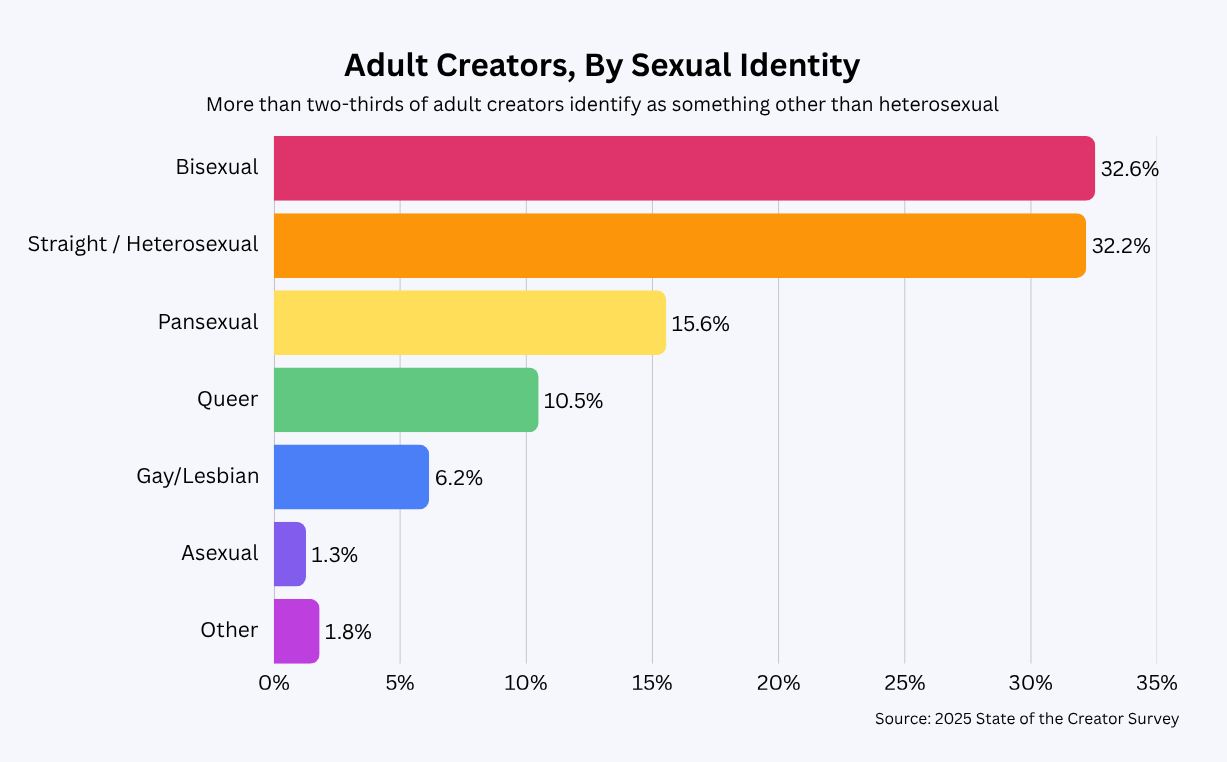
The data has been consistent over multiple surveys.
Women make up the lion’s share of the creator community (74%). More than two-thirds (68%) identify on the LGBTQ+ spectrum.
Bisexuals make up the single largest identity within the creator community. Nearly 1/3 of creators (33%) identify as bisexual, while another 16% identify as pansexual. Just 6% identify exclusively as gay or lesbian.
1 in 10 adult creators identify outside the gender binary. These creators are the most sexually diverse group. None identified as straight and just 3.7% identified as exclusively gay or lesbian.
Men are much more likely than women to identify as straight, but even then … it’s bare majority.2 More than half of male creators (52%) identify as straight, compared to just 32% of women. Straight male creators made up just 9% of respondents in our latest survey.3
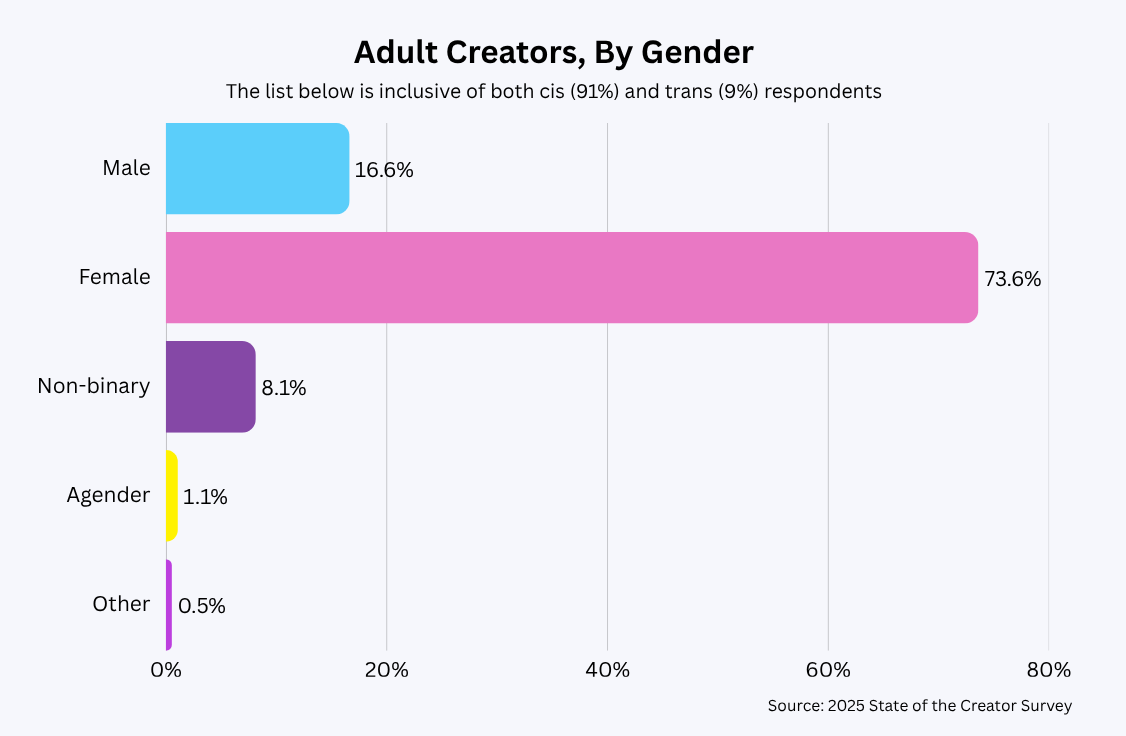
Creators were asked separately about their gender identity (above) and whether or not they identified as trans. The gender breakdown of the 9% of trans respondents: 51% non-binary, 29% female, 12% male, and 8% other. Sample sizes in these sub-groups are small enough that results should be read as suggestive rather than conclusive, and may not reflect the broader creator population.
Since the majority of the industry is at least a little gay, it can make it hard to see how queerness impacts creators’ incomes and experiences. After all, queerness here refers to a creator’s identity, rather than the type of content they make. That said, there appears to little difference between how much heterosexual and LGBTQ+ creators earn, even after accounting for gender.
But there’s another story lurking below the surface, one that’s especially worth calling out during Pride. Trans and/or nonbinary creators are earning significantly less on average than their cis counterparts.4
Earlier this year, we reported that adult creators earned an average of about $59,000 from adult work in the past year. But that average contains a huge range of experiences that vary by gender, race, industry sector, experience and other factors. The difference between cis creators and more gender diverse5 creators is particularly striking.
Cisgender creators earned an average of $62,000, while more gender diverse creators earned just $41,000 — about 66% of what cis creators earned. The reasons for this are complex and varied. Platform and algorithmic bias, stigma, market size and increased censorship all play into it. So may age, gender presentation and health status.6
Political and cultural attacks on the industry have also hit gender diverse creators the hardest. On nearly every question related challenges growing their business, gender diverse creators reported disproportionate impacts.
Compared to cis creators, trans and non-binary creators were:
83% more likely to have had their content used in a deepfake (14.9% vs 8.1% cis)
54% more likely to have been doxxed or outted online (32.4% vs 21.1%)
15% more likely to have had content flagged or removed (70.3% vs 61.2%)
15% more likely to have been banned from an adult platform (18.9% vs 16.5%)
They’re also the front lines of the War on Porn. Thanks to new restrictions like age-verification and political campaigns against sex and sex work, trans and non-binary creators were:
74% more likely to report being attacked or harassed online (33.8% vs 19.4%)
53% more likely to face restrictions on what they sell (74.6% vs 48.6%)
41% more likely to have fans unable to access their content (56.3% vs 40.0%)
24% more likely to report decreased revenue (60.6% vs 48.9%)
This data point to both significant societal and structural inequities for trans and non-binary creators, on and off adult platforms. Gender diverse creators are facing greater policing, greater levels of harassment and may be subject to greater scrutiny for the content they make. All while working in a legal and social increasing hostile to queerness and transness.
The data likely confirm what trans and non-binary creators already know, but few platforms acknowledge: for all it’s sexual diversity, the industry has significant work to do when it comes to gender diversity. Hopefully, as we close out Pride month, the data can be used to advocate for more than a rainbow-colored logo one month a year.
And for the rest of the LGBTQ+ community, give it up for the sex industry. We’ve built a thriving queer economy that other industries can only dream about.
In our most recent State of the Creator (2025), just 32.2% of creators — less than one-third — identified as straight or heterosexual. While the data are slightly complicated (a small number of the straight creators identified as trans or non-binary), more than 68% of creators identify as something other than cis / hetero.
“Men” and “women” here is inclusive of both cis and trans men and women, though the numbers here are more representative of cis creators. Trans creators are much less likely to identify as straight than cis creators, however the sample size is significantly smaller, particularly among trans men (n=6) to draw definitive conclusions.
Some of this may be attributable to our slate of respondents, which we suspect skews more heavily female and underrepresents M4M creators. You can read more about our methodology (and its strengths and weaknesses) here.
About 13% of creators (n=74) we surveyed identified as either trans or non-binary (for simplicity, we’re including a relatively small amount of creators who identified as “agender” or “other” in this calculation, though they are distinct identities). About 5% (n=29) identified as both non-binary and trans.
We use “gender diverse” here as a catchall for trans, non-binary, agender and others who don’t identify as cis. It’s at best, imperfect and arbitrary. As with designations like LGBTQ+ and gender non-conforming, there are significant differences within various identities and significant overlap with others, both of which can result in some degree of erasure.
More work here is needed to untangle the degree to which various factors impact income. Younger creators generally earn less than older creators, and are also more likely to identify outside the binary. Gender diverse creators are more likely to say they live with a chronic illness or disability, which may also impact income. Creators who identify as either trans or non-binary (but not both) tend to earn more than those who identify as both trans and non-binary. But the respondent size is significantly smaller as we further divide identity into tranches, so increasingly volatile and potentially impacted by other factors.
As a Queer Femme whose birthday it is today, I LOVED this read! Adult work is LGBTQ+ friendly and I hope people feel comfortable to be their full authentic selves in the space; they deserve to!
70% of adult creators identify as LBGTQ+ (and the majority of them are women). Why isn’t adult given more recognition as a queer economy?